Показват се публикациите с етикет Biennale. Показване на всички публикации

четвъртък, 13 януари 2011 г.

Veneziano dell'anno 2010

Domenica 16 gennaio alle ore 10.30 nelle Sale Apollinee del Teatro La Fenice, l'Associazione Settemari conferirà il riconoscimento di VENEZIANO DELL'ANNO 2010 a Paolo Baratta, Presidente della Biennale di Venezia.

Per me I VENEZIANI DELL'ANNO 2010 sarano altri. I miei cari amici di Venezia che stimo moltissimo. Gli voglio bene anzi.

Photocredit: La Biennale di Venezia su Facebook

Il Presidente della Biennale di Venezia, Paolo Baratta, insieme alla Direttrice Bice Curiger della 54. Esposizione Internazionale d'Arte ( 4 giugno - 27 Novembre 2011): ILLUMInazioni - ILLUMInations.

събота, 28 август 2010 г.

la Biblioteca dell'Archivio Storico delle Arti Contemporanee

Venerdì 27 agosto 2010 (ore 12.00) è stata inagurata la Biblioteca dell'ASAC (Palazzo della Biennale, Giardini).

La realizzazione della Biblioteca della Biennale ai Giardini segna anche il sospirato completamento dell’ASAC (l’Archivio Storico delle Arti Contemporanee) e la sua ritrovata piena funzionalità, dedicata principalmente a Venezia. La Biblioteca al Palazzo delle Esposizioni della Biennale si accompagna al progetto di riorganizzazione e riqualificazione dello stesso come edificio espositivo, ma anche polifunzionale.


La nuova Biblioteca dell’Archivio Storico delle Arti Contemporanee (ASAC) trova oggi finalmente postoin un’ala completamente ristrutturata del Palazzo delle Esposizioni ai Giardini, ora ultimata in concomitanza della vernice della 12 Mostra Internazionale di Architettura.
Una sistemazione straordinaria, questa, della storica Biblioteca della Biennale, sia dal punto di vista funzionale, sia della qualità architettonica, con elevati standard di consultazione, con sale di lettura per il pubblico, per gli studenti di Venezia, per i ricercatori e per i visitatori delle mostre.


Dopo 10 anni la Biblioteca viene dunque completamente riaperta al pubblico, e viene restituita alla città in una struttura riqualificata: una sede ideale anche perché viva, a stretto contatto con le manifestazioni della Biennale.

Photocredit: La Biennale di Venezia (grazie a Facebook)

La prima fase della realizzazione si era conclusa a giugno 2009 – in occasione dell’apertura della 53 Esposizione d’Arte – e aveva comportato il recupero di alcuni locali per la consultazione di libri, cataloghi, periodici di Arti Visive.

Una foto del palazzo delle Esposioni o della Biennale durante la 53 Biennale d'Arte Fare Mondi Making Worlds 07.06 - 22.11.09

Ora troverà collocazione anche la restante parte dei volumi e periodici della Biblioteca, riguardanti Architettura, Cinema, Danza, Musica, Teatro.

In questa foto vedete l'aspetto che avrà il Palazzo delle Esposizioni o della Biennale durante la 12 Mostra Internazionale di Archietettura detta anche Biennale di Archietettura 29.08 - 21.11.2010

Immagini e fonte: La Biennale di Venezia su Facebook

петък, 27 август 2010 г.

La Sala delle Colonne a Ca' Giustinian

La Biennale di Venezia su Facebook da un po’ di tempo annunciava che in occasione della 12 Mostra Internazionale di Architettura (29 agosto – 21 novembre 2010) sarebbero inagurati due nuovi spazi della Biennale, la Sala delle Colonne (al primo piano nobile di Ca' Giustinian) e la Biblioteca dell'ASAC (l’Archivio Storico delle Arte Contemporanee) al Palazzo della Biennale detto anche delle Esposizioni nei Giardini).

L’altro ieri, il 25 agosto, come era in programma alle ore 11.00 è stata inaugurata La Sala delle Colonne a Ca' Giustinian, dall’anno scorso di nuovo sede della Biennale di Venezia. Questa Sala delle Colonne è la famosa sala del primo piano di Ca' Giustinian, risalente agli anni '30 che diverrà il luogo ideale per meeting, workshop e soprattutto spettacoli dal vivo.

Photocredit: La Biennale di Venezia (grazie a Facebook)

Il mio caro amico Sergio Piovesan mi aveva detto che agli inizi degli anni '70, era agibile per concerti e spettacoli (anche 700 persone), ed lui, con il suo coro che presenta già da 27 anni coro, ha cantato anche lì! Allora Ca’ Giustinian era sede dell'assessorato al turismo e le due sale (quella degli Specchi e la Sale delle Colonne) erano adibite ad incontri, conferenze e concerti. Poi le sale, per ragioni di sicurezza, non sono più risultate idonee e quindi non più disponibili. Dall’estate scorsa in occasione della 53 Biennale di Arti Visive l’antica Sala degli Specchi ospita di nuovo i visitatori che vanno nella nuova cafeteria “L’ombra del Leone”, al piano terra, con vista sul Bacino di San Marco, una cafeteria, nonché salotto per la città rivolto a iniziative culturali.

Inoltre, proprio nella Sala delle Colonne è ospitato l’Evento Speciale della Biennale Architettura 2010, LUMA/ Parc des Ateliers, di Frank O. Gehry e Gehry Partners, LLP, un progetto architettonico per un nuovo modello culturale situato nel centro di Arles, Francia (apertura al pubblico: 29 agosto – 11 settembre 2010).

Photocredit: La Biennale di Venezia (grazie a Facebook)

Nella foto un momento dall'inaugurazione: oltre al Presidente della Biennale di Venezia, Paolo Baratta erano presenti anche l'architetto Frank Gehry e Maja Hoffman ( Luma) che hanno presentato il progetto, il sindaco Giorgio Orsoni, la Direttrice della prossima 54 Esposizione Internazionale d'Arte e Vittorio Sgarbi, prossimo curatore del Padiglione Italia per la 54 Esposizione Internazionale d'Arte.

Allo stesso tempo, al Portego Ca’ Giustinian (pianoterra) è stata presentata la mostra Biennale Works in progress. Undici anni: realizzazioni e progetti in corso che illustra i progetti realizzati dalla Biennale di Venezia per le proprie sedi negli ultimi undici anni, nonché i progetti in corso.

Photocredit: La Biennale di Venezia (grazie a Facebook)

Immagini e fonte: La Biennale di Venezia su Facebook

събота, 24 юли 2010 г.

The true artist helps the world...


The United States Pavilion at the Giardini della Biennale
Bruce Nauman, June 7 - November 22, 2009

Embracing the entire perimeter of the U.S. Pavilion's frieze is a recreation of Nauman's 1983-88 landmark outdoor neon sign, Vices and Virtues (permanently installed at the University of California, San Diego).


Bruce Nauman
American, Born 1941
The True Artist Hepls the World by Revealing Mystic Truths (Window or Wall Sing)
1967, neon


What are we to make of this curious statement? Should we believe it? Is this the artist's subjective opinion, or something that is objectively true? Even Nauman has stated an ambivalence towards the sign: "The most difficult thing about the whole piece for me was the statement. It was a kind of test - like when you say something out loud to see if you believe it. Once written down, I could see that the statement [...] was on the one hand a totally silly idea and yet, on the other hand, I believed it. It's true and not true at the same time. It depends on how you interpret it and how seriously you take yourself. For me it's still a very strong thought."


сряда, 14 юли 2010 г.

Bruce Nauman in Ca' Foscari


Bruce, we like you! написахме на тръгване в книгата за посетители. Тази снимка обаче я направих на влизане, преди да ме възпрат с ръкомахане, понеже снимките не бяха позволени. Организаторите искаха хем Брус Науман да се окичи с лаврите на победител в Биеналето спечелил "Златния лъв" за национално участие, хем ако може интернет да не се наводни с любителски снимки на неговите работи. Грешка, защото няма артист, на който популярността да вреди.


Giorni, 2009
Audio (forteen channels) по седем от ляво и дясно на залата, от които се чуваше запис на глас с една и съща поредност на дните на всеки от седемте реда
14 min, 28 seconds, continuousplay
One audio source consisting of one audio file, fourtieen speakers, two amplifiers and additional equipment.

Дотук същото като в книжката, но аз си записах и имената на италианските участници в записа. Вече бяхме чули гласа на Крис в инсталацията, "визията" на "Сватбата в Кана" на Веронезе осъществена от Питър Грийнуей в рефе(к)тория на Сан Джорджо Маджоре, така, че си записах от уважение към гласовете. В книжката имената ги няма, но ги намерих заедно с една снимка от записа на www.naumaninvenice.org

Participants in recording:
Valentina Barboni, Laura Bruni, Daria Carmi, Marco De Michelis, Franco Perrone, Tomaso Speretta and Daniele Zocco.

7 гласа на 7 човека удвоени на всеки ред, за всеки от 7те дена от седмицата, като преминаваш през залата чуваш различната поредност на дните изреждани разбъркано от различните гласове, поредности в които се повтаряха Mercoledì, Lunedì, Venerdì, Sabato, Sabato, Domenica, Lunedì, Martedì, Martedì, Mercoledì... Вариациите са безкрайни, всеки ден всъщност е обагрен от различни преживявания, колкото и монотонно да минава седмицата.
Тук там столчета, за да се поседне посетителя и да се наслади на срещата на дните изговаряни от различни гласове.

Снимката увенча нахалството ми, защото вече бях разбрала, че е най-грижливо пазената работа. В интернет не намерих нито една снимка от Дните, а преди това същия ден във Венецианския Университет по Архитектура, където в Aula Magna, бившия рефе(к)торий на манастира при църквата Толентини където бе разположен английския вариант на Дните щом ме видя да влизам с фотоапарата момичето страж скочи насреща ми с вик NO PHOTO. Там имаше едни тежки като в църква завеси на входа, които скриваха залата от погледа на запътилите се натам, бяха сложени за да изолират звука. И като влезеш, ахваш. Days ме поразиха, още там казах на Иво, че би ме си искало да го бях измислила аз. В "Ка Фоскари" човек се изкачваше по вътрешните стълби към piano nobile и се озоваше в залата с дните (без завеси), в която бяха окачени 14-те бели квадратни пана, бели квадрати 50 х 50 см, (бели като tabula rasa?) от които идваха гласовете. За нас това бе шедьовъра на Науман не само от серията Sound and Space.
Работа направена специално за Биеналето Fare Mondi Making Worlds, (имам предвид италианските Дни) нова от същата 2009 година, най-впечатляващата. Който беше видял Брус Науман само в американския павилион в Градините на Биеналето можеше и да реши, че кралят е гол, но не и този, който видеше старите и новите му работи в двата университета. Ние с Иво малко по-рано същия ден бяхме чули дните на седмицата в английския вариант при Толентини и каква бе изненадата ни когато се озовахме сред тези на италиански в "Ка Фоскари", по-точно в някогашното pòrtego на добавения впоследствие към университета някогашен палацо Джустиниан.

Снимката бях твърдо решена да я щракна, макар и без да имам възможност да обхвана цялата зала, просто я направих зад гърба на Иво, като му казах "Прикривай ме". Бързо, без да дам никакво време на момичетата пазачи да ме спипат. He, че не видяха. Уловила съм двама захласнати слушатели, хипнотизирани от ефекта с редуването на дните.

Английските дни ми хареса повече, бяха първите които видяхме и чухме, италианските ми звучаха различно, но пак бяха въздействащи. Английските се казваха Days, италианските Giorni и естествено звучаха на съотния език в смесена варираща поредност. В италианските нямаше глас на дете, в английките имаше и единствено детето ги изреждаше подред. Английските гласове като цяло ми се сториха по-изпипани. Помня все още два от тях, интонациите, паузите, поредността на дните, повторенията. В Ка Фоскари при италианските Дни, дебненето малко ме изтощи, пък и ми отне доста време да препиша description-a.


Smoke Rings (Model for Underground Tunnels), 1979-80
Assemblage comprised of two scultures: the first of eight parts of white plaster, the second of eight parts of green plaster, both resting on wooden mounts
Centre George Pompidou, National Museum of Modern Art - Center for Industrial Creation, Paris. Purchased 1985.

Това си го преписвам от книжка с Topological Gardens на Брус Науман, тази безплатната предложена на посетителите на излизане и влизане. (Ние си взехме такива на излизане.)

В нея има срахотна малка черно бяла снимка от 70-те години на клетката, ако съдя по вида на мъжа в нея - Double Steel Cage Piece от 1973. Беше монтирана в една отделна стая на приземния етаж, пазена зорко от студентка страж, не можеше и да се влезе вътре, където разтоянието между двете клетки една в друга беше по-тясно и от най-тясната венецианска calle. Aбе не знам защо не можеше да се снима, сигурно защото на снимките направени от посетителите нямаше нямаше да изглежда така както авторът би искал. От 1980г. двойната стоманена клетка е в един музей в Ротердам - Museum Boijmans Van Beuningen. По-готина е от всички стари боклуци на нашия Кристo.

Иначе пръстените, дето се оказаха Smoke Rings проекти за тунели на живо изглеждаха доста тъпо, но излязоха страшно фотогенична работа. Трябваше ми доста време да осъзная, че тези безсмислени "рингове" са вдъховени от кръгчетата дим, които обичат да правят самовлюбените пушачи. Естествено, веднага ме зърнаха, че снимам, за да ми направят поредната забележка. В края на краищата онези момичета за това бяха там и за това всъщност им плащаха, да обслужват взелата застрашителни размери американска параноя.

Untitled
1970/2009
Video (color, sterio sound), continuons play
One video source, two video projection, one sterio amplifier, two sterio speakers
4.6 x 4.6 m
This performance was conducted and recorded in February 2009 in the same room at the Exhibition spaces at University Ca' Foscari as it is installed in Topological Gardens.

Dancers:
Carlotta Borasco, Elena Dall'Acino, Irene Giubilini and Monica Soccol
Choreography: Silvia Salvagno

Това беше много готино, поне на мен ми харесаха минутите отброявани от гимнастичките, направих цели две снимки под заплахата да бъда изхвърлена или преносно казано издърпана за ухото. Истината е, че донякъде имаха право, защото беше много по-хубаво за гледане отколкото за снимане. Принудиха ме обаче вместо да снимам описанието на тази site specific instalation с фотоапарата, да си го преписвам на ръка. Ето защо някои използваха микрофони на Биеналето. В Арсенала аз снимах description-a, а един г-н си го четеше на микрофона. Ама за да имаш микрофон, трябва да си харесваш или поне да си свикнал с гласа си.


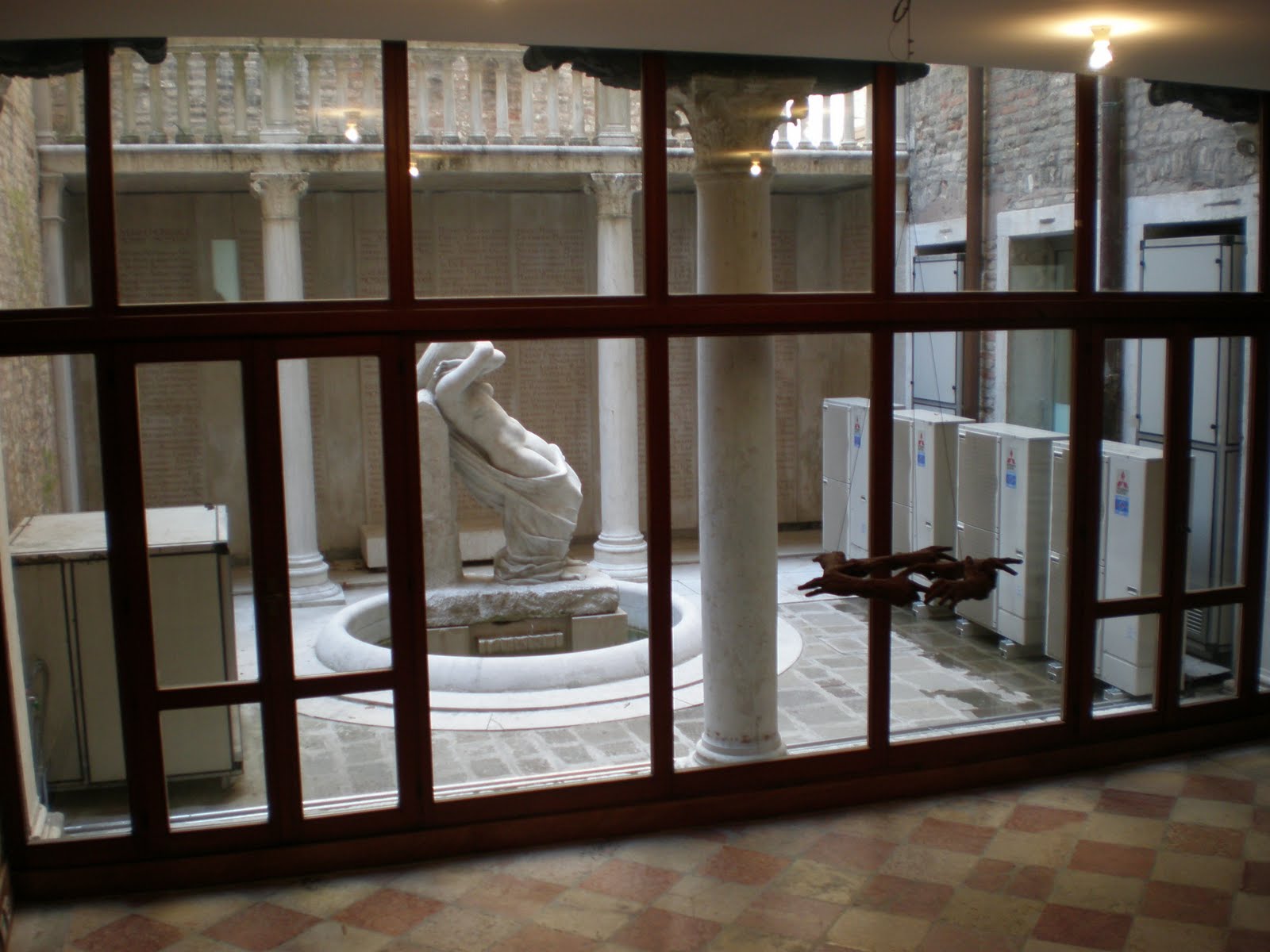
Untitled (Hand Circle) , 1996
Phosphorus-patinated bronze with wire
Indianopolis Museum of Art. Henry F. and Katherine DeBoest Memorial Fund and Mr. and Mrs. Richard Crane Fund.

Така е описана тази работа с ръцете в книжката, (която човек можеше да си вземе безплатно на Биеналето) която е от серията Heads and Hands.

И после ще ми говори някой, че американците не ценели изкуството. Богатите са луди за изкуство, това съм го разбрала.

Хубаво е да се види жеста показан от окачените като полилей ръце. Това е международния жест за правене на секс, който със сигурност кефи Брус Науман, така както кефи и мен. Неприличен и буквален и секси, там при бронзираните ръце е удивително изискан. Доста по-дързък изглежда при неоновата работа, с разноцветен неон Human Sexual Experience от 1985. Все си мислех, че съм го снимала, но не, оказа се, че се е отпечатил в паметта ми, с размера си, цвета си, чувството за хумор. Честно да си кажа, завиждам на тези колекционери, които знаят какво да купуват. Neon tubing on aluminum monolith Marc and Livia Straus Family Collection Exhibition copy.

Обаче в американския павилион снимах други неонови работи, един Разговор в който всеки един от говорещите бърка с пръст в очите на другия. Също недвусмислена и директна работа с неон, запазената марка на Брус Науман.

Накрая ще кажа, че там в Ка Фоскари разгледах някои албуми с работи на Науман, от онези албуми, които остават на разположение на най-любознателните или любопитните от посетителите и в един от тях видях една снимка на Брус Науман от младите му години пред ателието. Представете си Холдън от "Спасителя в ръжта" пораснал с няколко години, учил математика в университета и още там станал Artist и голяма звезда. Висок, строен и по американски секси. Няма толкова готин американски актьор колкото ми се стори Брус Науман като млад пред ателието си. Ще продължа да пиша за него, защото има какво да кажа.

Предстои да представя и 7 гряха или ако препочитате Добродетелите и Пороците в неговия неонов вариант по външните стени на павилиона на United States of America в градините на Биеналето.

сряда, 30 юни 2010 г.

Martine Boyce, No Reflection


Martin Boyce lives and works in Glasgow.
Born in Hamilton, Scotland, in 1967, he is one of Scotland's most prominent artists and is well-known for his sculptural installation that recall and make reference to conventional public spaces - the playground, pedestrian subway, deserted or abandoned sites.


Martin Boyce in conversation the the curator Judith Winter, April 2009

What the process of finding the site meaningful to the work?

The process of looking for sites was useful in piecing the city together and in understanding some of the previous Biennale situations, but with no specific project or works in mind there were no clear parameters on what we were looking for. We looked at outdoor sites, a large overgrown football pitch surrounded on three sides by old walls, cloisters in the north of the city, a school close to the Giardini. The overriding sense as time passed and we made more site visits to Venice was how would I know when it was the right place? What would those conditions be? What work would follow the site? In October last year we saw a large hall, The Ecole Mercanti, Santa Maria Dell'Orto and the interconnected rooms of Palazzo Pisani, Santa Marina.


Haw did you make the decision about site?

Initially, the singular expanse of the Ecole Mercanti seemed like the best option and we begn to pursue thies site. [...] However, even on the plane journey back from Venice I began to imagine certian forms and elements appearing in the rooms of the Palazzo, there was something in the atmosphere and the jorney through the different rooms that stayed with me. It had a sense of abandonment that the other space didn't and that somehow opened un a whole set of possibilities for the work. For some reason I kept imagining the Palazzo as an abandoned garden and this and those initual ideas formed on the plane became the core of the exhibition.


The experience of Venice "out of biennale season" and the idea of the abandoned Island Torcello were also important in our conversation?

Once the decision of the site had been made and the place became fixed in my mind, it seemed as if the Palazzo was reflected in so many of our experiences of Venice.
The aftermath and residue of the previous Biennale was still present. It had this ghostly Mary Celeste-like quality, like waking up the morning after the party. Weathered posters and signage for 2007, the park itself unkempt and overgrown, the pavilions boarded up, it could have been two years or ten since a light had been switched on or a door unlocked.


Where does the title of exhibition come from?

Around the time I had been working on the Munster sculpure project I had been thinking about the idea of a deserted zoo. I had written a short text that tried to conjure un this image and in it there was this idea of dried up pools and how their former reflections had now evaporated and belonged to the air. Walking around the Giardini this came up and the title No Reflection stuck.


Can you say more about the form of the exhibition?

In a city built on the water, I felt that one way to introduce a number of materials, sounds or textures was through their absence. How do I introduce a pool into the second floor of a Venitian Palazzo? How does a series of interconnecting rooms become a walk through a hidden garden? How can the simultaneity of this and the acknowledgement of the site's true codition co-exist, where in a moment a classic Palazzo interior can become a frozen garden untethered from time, one landscape blown through another.


The architectual context is obviously very important to the experience of the work?

With only a few exceptions it appears that architectuarally Venice is so deeply rooted in the past that its layers of erosion and renovation are so interlaced that it's difficult to think of it as a city growing or developing. Even the modern, as with Scarpa, is old and woven through the fabric of the Middle Ages and Renaissance. I began to reflect on this on relation to the work in No Reflection, the weathered concrete steppinh stones, the worn steel table, the bird box constucted from old strips of wood. [...]


You bring together the abandoned private dwelling with public space and transform the meaning of everyday artefacts and experiences. It would be particularly interesting to know more about the way that your work triggers associations.

In a recent iterview I was asked, in relation to the name Boyce meaning "lives by the woods", if I had ever lived near woods. It triggered a memory that I hadn't consciously thought about for years. I was brought up in new housing estate surrounded by what we called "the woods"; as children we spent all our time playing in there. Across one the wider parts of the stream that ran through these woods, someone had dumped five or six bags of cement still in their paper wrapper. The paper was worn away and the cement had hardened creating a series of stepping-stones. They were known locally as the golden steps. I was already working on the stepping-stones for the first room when I was reminded of this but it illustrated perfectly the possiblity of something urban and everyday transforming into something special.


You have produced several pieces that refer to images of concrete trees. Could you say more about the history of these works?

Some years ago I came across a black and white photograph of four geometric, concrete trees made for a Robert Mallet Stevens garden in 1925 by the sculptors Joel and Jan Martel. [...]

How do you re-use this tree form?

One of the early ideas for Palazzo Pisani was to remove the existing Murano glass chandeliers and introduce sculpural replacements. The structure and shapes of the Martel trees had by now developed into a lexicon of forms: screens and fences, ventilation grills, architectural pillars, concrete floors, telephone booths, masks, tables... With each new work, rather that search for new forms or play off of existing ones, I would go back to the trees and see what new transformation they could endure. For example, by simply inverting the tree an incredible, geometric chandelier was born.


Secondo piano nobile di Palazzo Pisani (Santa Marina)
7 June - 22 November 2009

петък, 11 юни 2010 г.

BED di Ivan Navarro e scena 1, atto I della commedia per la faccina di Corto

Ecco una scena con cui può cominciare ATTO PRIMO della Commedia che mi sono messa di comporre dandole un titolo lavorativo “La guerra per la faccina di Corto Maltese”.

Scena 1, Atto I

La Signora Straniera e il Fotografo sono nell'Arsenale per vedere l'ennesima Biennale

(aspetto delle proposte per la scenografia, ne ho una ma forse è meglio che non la mostri proprio all’inizio, no so... ok, via, ve la faccio vedere perché mi piace un sacco! )


La Signora:

Sai cosa mi chiedevo ieri rileggendo “Fondamenta degli Incurabili”... Mi sai dire se essiste un nisoietto con questa scritta o Brodsky l'avra inventato? Te lo chiedo perchè non l’ho trovato sulla cartina e non mi ricordo di aver visto altro che un nisoietto "Ponte agli Incurabili".

Il Fotografo:

Esistono: 'Calle degli Incurabili', 'Campiello e calle drio agli Incurabili', 'Campiello drio agli Incurabili, 'Ramo agli Incurabili' e 'Fondamenta Zattere agli Incurabili'. Lungo quest'ultima c'è anche un targa dedicata a Brodskji.

La Signora:

Grazie, non volevo infastidirti ma sai dirmi cosa significa "drio" in veneziano? viene dal "rio" o vuol dire “dritto”?

Il Fotografo:

Non mi infastidisci affatto, anzi! ;-)
'drio' vuol dire 'dietro', quindi una calle drio qualcosa vuol dire che è dietro quel qualcosa! ;-D


Ivàn Navarro (l'accento cade come in bulgaro o in russo) was born in 1972 in Santiago, Chile, where he grew un under the dictatorship of General Augusto Pinochet. From 1991 to 1995 he studied art at the Universidad Catòlica de Chile, graduating with a degree in printmaking.
In 1997 he moved to New York where he has lived and worked ever since. For the last 10 years his work has been primarily sculpture based on light.

una scena della commedia nella quale parlano il Fotografo e Sig. Bauta e Tabarro


Questa è un’altra scena della commedia (nella quale farà parte anche Corto Maltese) in questa scena vediamo il Fotografo e Sig. Bauta e Tabarro

Sig. Bauta e Tabarro:

Sono un collezionista di fumetti (ne ho più di 10'000). Sono ugualmente un ammiratore dell'opera di Ugo Pratt che ho avuto l'occasionde di incontrare a diverse riprese.

Il Fotografo:

caspita, 10.000 fumetti!?!? usa una seconda casa per tenerli?

Sig. Bauta e Tabarro:

Non una seconda casa ma un locale affitatto apposta per poterli custodire. Sappia che il numero dei miei fumetti è ridicolo in confronto alla biblioteca di Ugo Pratt. Lui aveva un tesoro di più di 40'000 libri in diverse lingue e su numerosi temi. Quando faceva visitare casa, diceva entrando in una stanza: "Questa è la camera dei pirati e dei mari del Sud!". Tutte le stanze erano piene di libri ed ognuna con il suo tema... costumi, esoterismo, ecc. Quando morì Ugo, la sua biblioteca è stata messa a disposizione del festival del fumetto per il quale ho collaborato per ben 15 anni. Quando il festival ha smesso per raggioni finanziarie, i libri sono tornati alla fondazione Cong di Losanna e chissà cosa sono diventati...

Il Fotografo:

Questa della Fondazione Cong di Losanna non la sapevo... sarebbe interessante scoprire che fine hanno fatto tutti quei libri... foss'anche solo per l'idea che sono stati muse per il Maestro sono di valore inestimabile!
E così, oltre all'amore per Venezia, abbiamo in comune anche la passione per i fumetti... e son contento che possiamo fare qualche chiaccherata più approfondita, credo che abbiamo molte cose di cui parlare!

Sig. Bauta e Tabarro:
(quarda il suo orologio)
Possiamo prendere anche adesso un “fumetto-spritz"... Lei che di tanto in tanto è a Torino, mi sa dire se il Torino Comics vale la pena di essere visitato? Tra l'altro a Torino sono in contatto con Massimiliano Frezzato... lo conosce?

Il Fotografo:

Se conosco Frezzato? ma certo che lo conosco! tanti anni fa, quando ancora non era molto famoso gli proposi una mia sceneggiatura che gli piacque, ma poi non se ne fece nulla... non credo nemmeno che lui se ne ricordi, è passato davvero tanto tempo! Anyway, il Torino Comics non è all'altezza di altre manifestazioni più blasonate, ma è comunque sempre piuttosto interessante.

photo by Pierre Pareja scaricata dal suo blog Venice Daily Photo

четвъртък, 3 юни 2010 г.

Cildo Meireles e i colori complementari, primari e secondari

Consiglio a tutti di vedere la foto che aveva scattato Anne dell'installazione di Cildo Meireles CLICCATE QUI PER VEDERLA

Pling Pling, 2009
Installazione, 6 stanze colorate con proiezioni (dei colori primari e secondari)
Arsenale, 53 Biennale Fare Mondi 2009 (vistitato il 16 sett, il giorno del Diluvio :)

E' una materia che amavo spiegare a scuola perché era una delle poche cose che riuscivano a capire proprio tutti. Se qualcuno ha bisogno di spiegazioni sui colori, li spiego anche qua volentieri.

I colori primari sono tre: rosso, giallo e azzurro
I colori secondari sono tre: arancione, verde, viola
Ci sono anche i colori terziali come il marrone.

Quali sono i colori complementari detti anche antagonisti?

rosso - verde
giallo - viola
azzurro - arancione

E perché? Perché il rosso come colore primario non fa parte del verde come colore secondario composto dal giallo e blu.
Ed anche il giallo come colore primario non fa parte del color viola o violetto, un colore secondario composto dal rosso e blu.

Chiaro, eh?

giallo e viola, colori complementari detti anche colori antagonisti

blue

viola

Cildo Meireles è un brasiliano, nato a Rio de Jeneiro nel 1948 e vive e lavora lì.

Ecco che cosa ha scritto su di lui il direttore della Biennale Fare Mondi o uno dei suoi collaboratori:

L'arte di Meireles trae la sua forza dalla fusione di concetto e oggetto, di intentità e materialità. Fin dai tardi anni '60 l'artista è impegnato a sperimentare varie tecniche e strategie. Nel suo lavoro il colore ha sempre avuto un ruolo importante, a volte per la sua pregnanza simbolica, altre volte, invece, come in Pling Pling per la sua qualità fisica.

Meireles' art derives its strength from the unity of concept and object, of identity and materiality. Since the late 1960s the artist has experimented with various strategies and techniques. Color has always played on important role, sometimes for its emblematic charge and sometimes, rather, for its physical quality as in Pling Pling.

Azzurro e giallo


BV09_DSC0630
Originally uploaded by walterfano
photo by Walter Fano

all'Arsenale della 53 Biennale Fare Mondi

un visitatore nell'installazione Pling Pling dell'artista brasiliano Cildo Meireles

Walter e i colori di Cildo Meireles


BV09_DSC0632
Originally uploaded by walterfano
photo by Walter Fano

all'Arsenale della 53 Biennale Fare Mondi

lo stesso visitatore entra nella camera rossa.

сряда, 19 май 2010 г.

Mille Fiori Venezia 2008


Biennale 2009 FARE MONDI MAKING WORLDS
Giardini, Padigliore Venezia
Mille Fiori Venezia 2008
Dale Chihuly
Courtesy Galleria Marina Barovier, Venezia